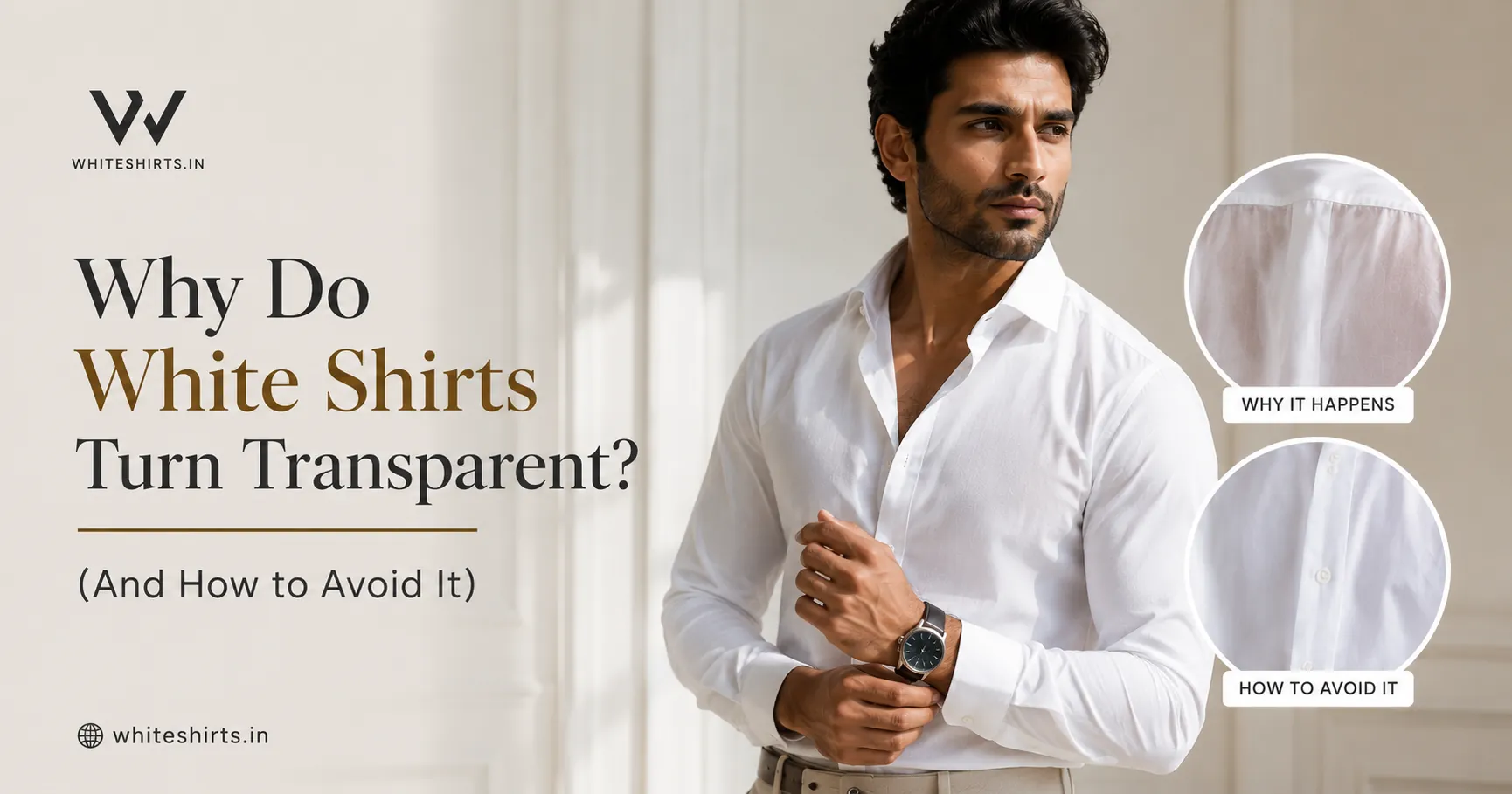
White shirts turn transparent because the fabric is too thin, too loosely woven, or made from short-staple fibre that lets light pass straight through. Sweat makes it worse by filling the gaps between fibres with moisture, which carries light even more readily. The fix is simple in principle: choose a denser, higher-quality cloth — long-staple Egyptian cotton or proper linen — woven tightly enough to block light. Here's the full explanation.
Few wardrobe moments are worse than realising — usually in a photo, or a glass building's reflection — that your crisp white shirt has gone see-through. It's not bad luck. It's physics, and it's almost always the fabric.
The three reasons white shirts go see-through
1. The fabric is too light
Opacity depends on how much fibre is actually between the light and your skin. Thin, lightweight shirting simply doesn't have enough material to block light. Manufacturers use thin cloth because it's cheaper and feels "breezy" on the hanger — but in daylight it betrays you instantly.
2. The weave is too loose
Even decent fabric goes transparent if it's loosely woven, because light passes through the gaps between threads. A tight weave — more threads packed into each square inch — produces a denser, more opaque cloth. This is why thread count matters: a fine weave around 140 threads is dense enough to hold light out while staying soft.
3. The fibre is low quality
Short-staple cotton (the cheap kind) spins into a weaker, fuzzier, less uniform yarn that scatters and transmits light. Long-staple fibres — like Egyptian cotton from the Nile Delta — spin into a smoother, denser, stronger yarn that's naturally more opaque. Better fibre, more opaque shirt.
Why sweat makes it dramatically worse
This is the part most men learn the hard way in an Indian summer. Dry fabric scatters light, which helps hide what's underneath. When fabric gets wet with sweat, water fills the microscopic air gaps between fibres — and water transmits light far better than air. The fabric effectively becomes a window. A thin shirt that's merely "a bit sheer" when dry can go fully transparent when damp.
The only real defence is starting with fabric dense enough that even damp, it doesn't surrender. Lighter, cheaper cloth has no margin.
How to test a white shirt for transparency before you buy
- The window test: hold the fabric up to a bright light or window. You should see shadow and a soft glow — not the clear outline of your hand.
- The hand test: place your hand flat behind a single layer of the fabric. If you can see your skin tone and finger definition clearly, it'll be sheer on your body too.
- The weight test: good shirting has a reassuring weight and "body" in the hand. If it feels flimsy and floats, it'll likely go see-through.
How to avoid it for good
Buy fabric quality, not price. A white shirt made from long-staple Egyptian cotton or proper Italian linen, woven tightly, will stay opaque in daylight and hold up far better when you sweat. It costs more upfront and saves you the cost — and embarrassment — of replacing see-through shirts every season. (Our white shirt buying guide covers exactly what to look for.)
COLUMN was built specifically around this problem. Its white shirts use single-origin Nile Delta Egyptian cotton spun to a 140 thread count, and four-generation Como-woven Italian linen — fabric dense and high-quality enough to be genuinely anti-transparency (and anti-yellowing), not by a coating that washes out, but by the quality of the cloth itself. Priced from ₹2,880, sizes S–XXL, in slim and regular fits, at WhiteShirts.in.
The bottom line
A white shirt goes transparent because of thin, loosely-woven, low-grade fabric — and sweat turns a minor problem into a major one. Choose a dense, long-staple cotton or quality linen, do the window test before you buy, and you'll never have that glass-building moment again. For shirts that pass every test, see the best white shirts for Indian men in 2026.